Whole-House Standby Generator Installation in Myrtle Beach, SC
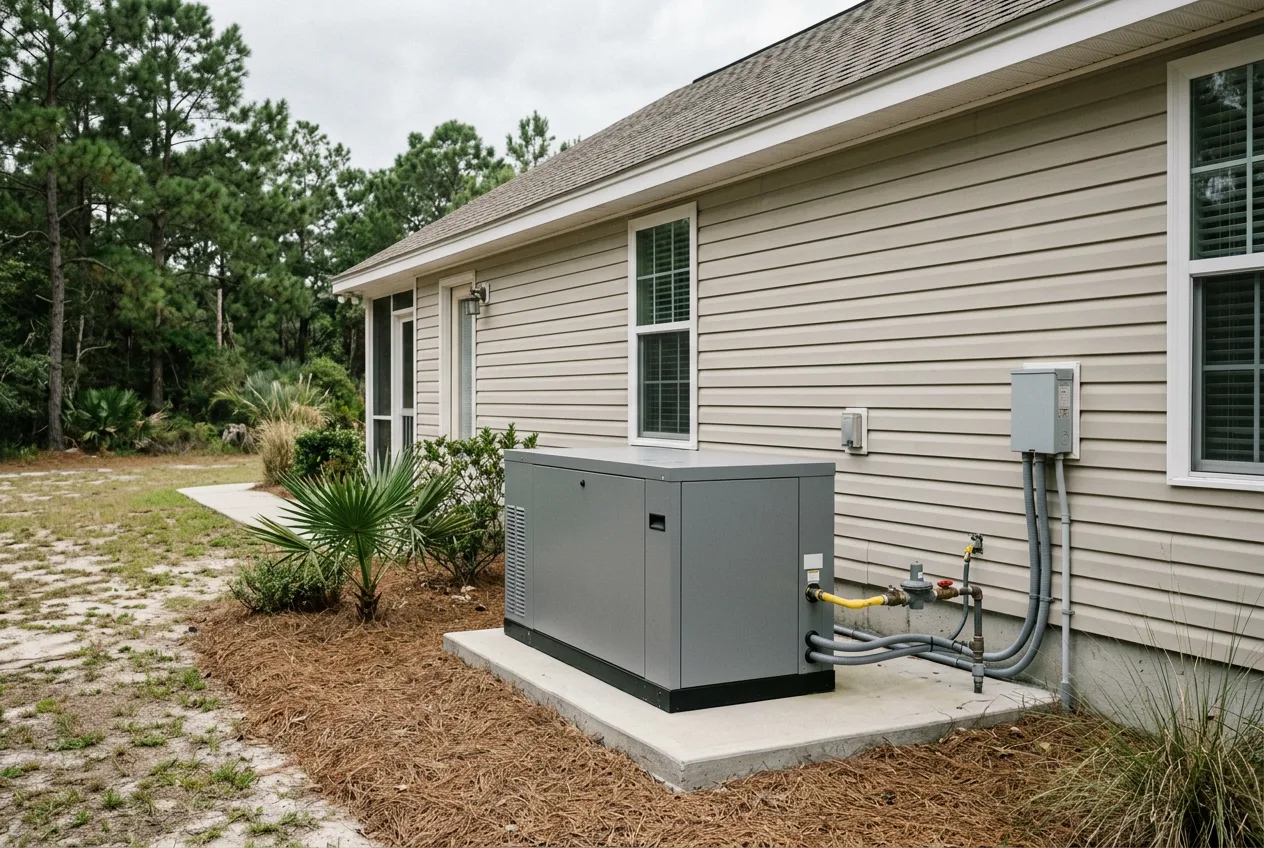
A fully installed standby system runs $9,000 to $25,000 in Myrtle Beach, covering the generator, automatic transfer switch, pad, fuel connection and permits. Whole house generator installation here runs toward the higher end when coastal siting or a longer fuel run is involved.
Standard scheduling runs during regular business hours. Ahead-of-storm-season demand books out early — see the hurricane prep guide for timing.
How much does a whole-house standby generator cost installed?
Kilowatt size is the single biggest driver, followed by fuel type and how far the unit sits from the gas meter or propane tank. A 13-17kW unit covering essential circuits sits at the low end; a 22kW-plus unit built to run central air and most of a larger home's circuits sits at the top.
Scope check
What Counts as 'Whole-House' vs. 'Essential Circuits'?
'Whole-house' doesn't always mean every circuit in the panel. It means a generator sized to run everything you'd actually want running at once, including the big surge loads like central air.
Essential-circuits systems, typically 13-17kW, cover the sump pump, refrigerator, furnace blower, a well pump if you have one, and a handful of outlet and lighting circuits. That's enough to keep a household functioning and safe through a multi-day outage without trying to run everything.
Whole-home systems at 20kW and up add central air conditioning, which changes the math more than most homeowners expect. An AC compressor's startup surge can run several times its steady-state wattage, so a generator sized only for running load can stall trying to start the compressor even though it would carry it fine once spinning.
That's the real reason sizing gets done with an actual load calculation instead of a rule like one watt per square foot, which ignores what's plugged in and what starts under load versus what just runs. See our full generator sizing guide for the worked math if you want to check a number yourself before calling.
What you get
What's Included in a Standby Install?
- Load calculation and sizingMatches generator capacity to your actual essential and desired circuits, including startup surge for AC and well pumps.
- Concrete pad, set level and to clearanceManufacturer-specified setback from windows, doors and vents, and near the coast, elevated to meet flood-zone requirements where applicable.
- Automatic transfer switchSized to your panel's amperage, wired to switch your home to generator power within seconds of an outage, no action needed from anyone.
- Fuel source coordinationNatural gas or propane sized and connected, coordinated with a separately licensed gas-fitting trade for that portion of the work.
- Permit and inspectionFiled with whichever Horry County jurisdiction covers your address, with the inspection scheduled as part of the job.
- Startup and transfer testA full simulated-outage test before the crew leaves, confirming the switch actually transfers power under load.
Step by step
How Does Whole-House Generator Installation Actually Work, Step by Step?
Site survey and load calculation
Time on site · 30-60 minutesAn electrician walks the property, checks the panel, and calculates the actual kW your circuits require, including startup surge.
Permit filed
Time on site · 1-3 weeks, jurisdiction-dependentElectrical permit, and usually a separate mechanical or gas permit, filed with the correct city or county office for your address.
Pad and equipment set
Time on site · 1 dayConcrete pad poured and cured, or an existing pad reused where a replacement allows it, then the generator set in place.
Electrical, fuel and transfer switch wiring
Time on site · 1-2 daysATS wired into the panel, generator connected to its fuel source, and all connections tested.
Inspection and commissioning
Time on site · scheduled separately, typically within a week of substantial completionLocal inspector signs off on the permitted work, then the system runs a full startup and transfer test.
A generator sized for what actually matters to you during an outage, installed to code, permitted, and tested under a simulated power loss before anyone calls the job done.
What it runs
What Drives the Price Up or Down?
| Item | Typical price |
|---|---|
| 13-17kW unit, essential circuits / installedCovers sump pump, refrigerator, furnace blower and select lighting/outlet circuits. | $9,000-$14,000 |
| 20-26kW+ unit, whole-home including central air / installedCentral air's startup surge requires a larger engine and a larger transfer switch. | $14,000-$25,000 |
| Long fuel line run (roughly 50+ feet from meter or tank) / add-onExtra trenching and pipe for natural gas, or a longer propane run. | +$500-$2,500 |
| Coastal siting: flood-elevation pad, corrosion-resistant enclosure / add-onMore common within a few miles of the ocean than in inland pockets like Carolina Forest or Conway. | +$1,000-$4,000 |
| HOA-required equipment screening / homeowner costFencing or landscaping to screen the unit; usually not part of the installer's quote but affects total budget. | $300-$1,500 |
These are typical ranges for Grand Strand; your exact price is confirmed after the load calculation and site visit, and can run toward the top of these ranges during peak hurricane-season demand.
See the generator installation cost guide for a full size-by-size breakdown.
Pick a fuel
Natural Gas, Propane, or Diesel — Which Fits This Property?
Availability · Ongoing fuel logistics · Best fit
Natural gas
Best for
Properties with existing gas utility service and a meter with spare capacity
Works when
- Runs continuously without refueling as long as utility service is intact
- No tank to site, screen or maintain
Costs you
- Not available at every Horry County address; a meaningful share of the coastal market runs on propane instead
- A larger gas meter may be needed, which adds cost and utility coordination time
Propane
Best for
Properties without natural gas service, which is common across much of the Grand Strand
Works when
- Works regardless of whether gas utility service reaches the property
- Tank size can be matched exactly to the generator's burn rate
Costs you
- Needs a tank sited with its own setback distance and often HOA screening
- Depends on periodic delivery, which can be a real constraint during a regional post-storm fuel crunch
Diesel
Best for
Larger commercial or multi-unit systems, rarely the right call for a single home
Works when
- No dependence on gas utility service or propane delivery scheduling
- Standard fuel type for larger commercial standby systems
Costs you
- Requires on-site fuel storage and periodic fuel testing to avoid degraded fuel
- Runs louder and is rarely available in a size that makes sense for a typical house
Verdict
Most Myrtle Beach homeowners end up on propane simply because natural gas isn't available at their address; where gas service already exists with spare capacity, it's usually the more convenient choice. Diesel isn't the right answer for a single-family home. That fuel belongs on the commercial generator page, not here.
Straight answers
How much does a whole-house standby generator cost installed?
$9,000 to $25,000 in Myrtle Beach, depending mostly on kW size, fuel type, and how far the unit sits from the fuel source. Coastal siting and hurricane-season demand can push a quote toward the top of that range.
How long does the power stay off during installation?
Typically a few hours, once, for the final electrical tie-in and transfer switch connection. The rest of the install (pad, fuel line, generator set) doesn't require your existing power to be off.
Do I need a permit for a standby generator in Myrtle Beach, SC?
Yes, almost always an electrical permit and often a separate mechanical or gas permit. Which office issues it depends on whether the address is inside Myrtle Beach, another Horry County municipality, or unincorporated Horry County. Filing it is handled as part of the job.
Are there noise or setback rules I need to know about?
Generators need a minimum clearance, commonly around 5 feet, from windows, doors and vents per manufacturer instructions and NFPA guidance, with some manufacturers allowing closer placement against a non-combustible wall after testing. Local jurisdictions can add stricter setback or noise-ordinance rules on top of that baseline.
Will an HOA have a say in where the unit sits?
In a large share of Grand Strand subdivisions, yes. Many HOAs require the pad and any street-visible equipment to be screened with landscaping or a fence panel, and that architectural-review approval is often the slower step in scheduling, ahead of the county or city permit.
Natural gas, propane, or diesel: which one should I choose?
Natural gas if it's already available at your address and the meter has spare capacity; propane if it isn't, which is common on this stretch of coast. Diesel is a commercial-scale fuel choice, not typically the right fit for a single-family home.
How is the generator sized for my house?
From an actual load calculation covering what you want to keep running and its startup surge, not a square-footage guess. Central air conditioning is usually the single biggest factor in whether you land in the essential-circuits range or the whole-home range.
Locked in.
Book it before the forecast turns.
A load calculation is a short site visit and gives you a real, written price, not a phone guess you find out was wrong once the crew shows up.
Call it in or send the details — a real quote comes back either way.