What Size Generator Do I Need for My House?
Most essential-circuits systems run 10 to 17kW, and most whole-home systems with central air run 20 to 26kW or more. The real number comes from adding up your actual circuit loads and their startup surge, not from square footage alone.
Standard scheduling runs during regular business hours. Ahead-of-storm-season demand books out early — see the hurricane prep guide for timing.
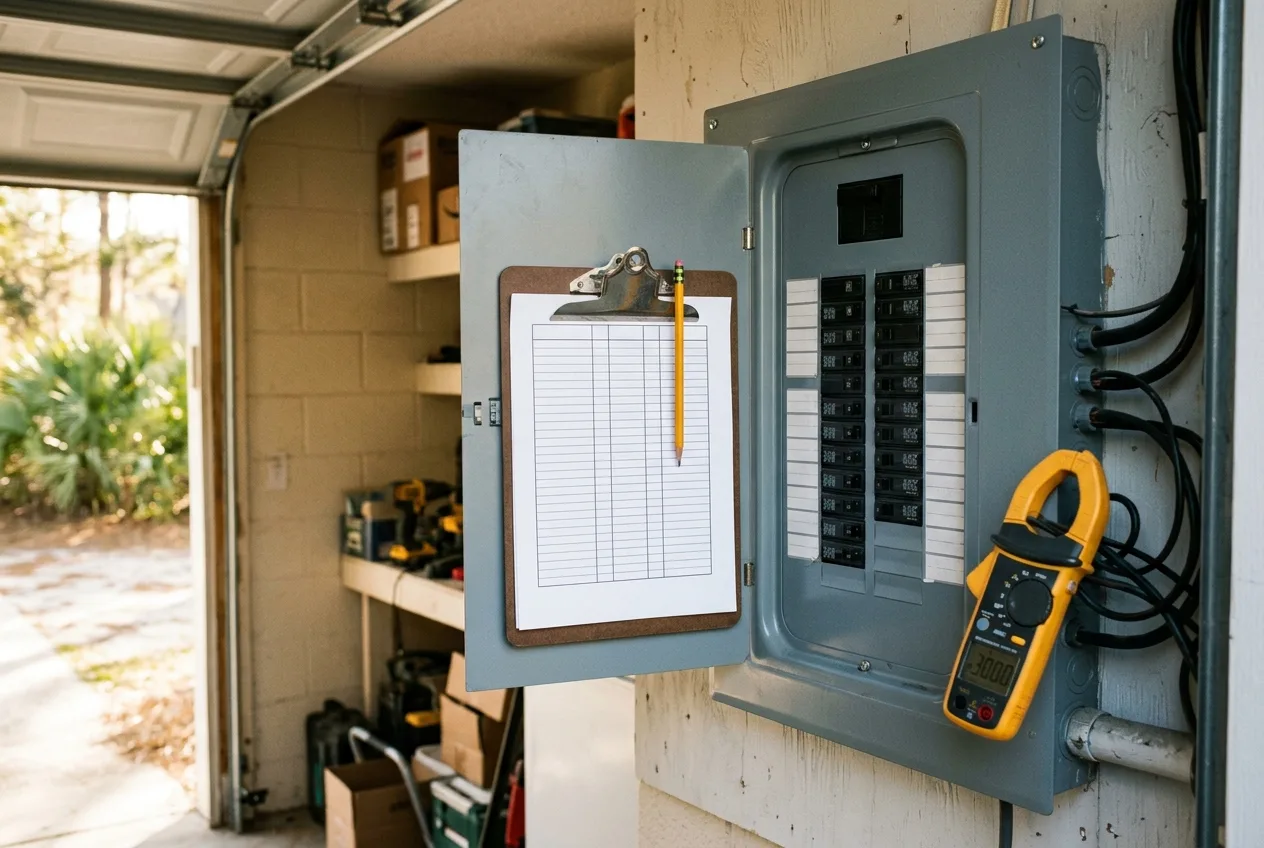
How many kW generator do I need for my house?
Square footage is a rough proxy at best. Two identically sized homes can need very different generators depending on whether one has a well pump and central air and the other doesn't.
The math
How Do You Actually Calculate Generator Size?
A real load calculation adds up two numbers for every circuit you want covered: running watts (what it draws once it's operating) and starting watts (the surge it pulls for a moment when it first switches on). Motors, like a well pump, a furnace blower, or a central air compressor, draw far more on startup than while running, sometimes two to three times as much for a second or two.
The generator has to be sized to handle the highest combination of starting surges that could realistically happen at once, on top of everything else already running. That's the piece a square-footage rule of thumb completely ignores: it doesn't know whether your home has a well pump and a 4-ton AC unit or neither.
A rough reference for common loads: a refrigerator runs around 600-800 watts with a startup surge near 1,200-2,200 watts; a sump pump runs 800-1,050 watts with a 1,300-2,150 watt surge; a furnace blower runs around 800 watts with a surge that can approach 2,300 watts. None of these numbers should be added up by hand as your final answer. That's exactly what the load calculation is for.
Scope check
Whole-House vs. Essential-Circuits: What's the Real Tradeoff?
Essential-circuits sizing asks: what do you actually need running to stay safe and functional through a multi-day outage? Typically that's refrigeration, a furnace blower or heat source, a well or sump pump if you have one, some lighting, and a handful of outlets for phones and medical equipment. That list fits comfortably on a 10-17kW generator for most homes.
Whole-house sizing asks a different question: what would you want running as if nothing happened? That almost always means adding central air conditioning, which is the single biggest jump in the sizing conversation. A 3-ton AC unit alone can require several thousand watts of running capacity and a startup surge that dwarfs everything else on the list combined.
Neither approach is wrong. The tradeoff is cost versus comfort: essential-circuits systems cost less and are smaller, but you're managing without AC and some conveniences during a long outage. Whole-house systems cost more but mean the outage barely changes daily life.
By size
Typical kW Ranges by Home Size
| Home profile | Typical kW range | Typically covers |
|---|---|---|
| 1,000-1,500 sq ft, essential circuits | 10-14kW | Refrigerator, furnace blower, sump pump, select lighting |
| 1,500-3,000 sq ft, essential circuits or light AC | 14-20kW | Essentials plus a smaller AC unit or a larger essential-circuits list |
| 3,000-5,000 sq ft, whole-home with central air | 20-26kW | Most or all circuits, including a standard central air unit |
| 5,000+ sq ft or multiple AC units/well equipment | 26-38kW+ | Larger whole-home coverage, sometimes requiring two units |
These are starting points for budgeting, not a substitute for a real load calculation, which is what an accurate quote is actually based on.
Warning
What Happens If You Undersize It?
Best case, the generator's protective controls shut it down before damage happens, and you find out the system's undersized during a test rather than a real outage.
Worse case, an undersized unit tries to start a large motor load (most commonly a central air compressor) and either stalls out, trips a breaker repeatedly, or runs the engine at a strain that shortens its life. None of these outcomes are what a homeowner pictures when they picture 'the generator kicks on.'
This is why a load calculation, not a guess, is worth the short site visit it takes. An undersized system doesn't just underperform. It can fail at exactly the moment it was bought to work.
Surge loads
Do Central AC and Well Pumps Change the Math?
Yes, more than almost anything else on the list. Central air's compressor startup surge is often the single largest load a residential generator has to handle, which is why adding AC to the coverage list is usually what pushes a system from the essential-circuits range into the whole-home range.
A well pump has the same issue on a smaller scale — it's a motor with a real startup surge, not just a steady draw. Homes with both a well pump and central air need both accounted for in the same load calculation, since their startup surges don't necessarily happen at the same moment, but the generator still has to be able to handle either one on top of everything else already running.
Straight answers
How many kW generator do I need for an average home?
Most homes land somewhere between 14 and 26kW depending on whether central air is included in the coverage goal. A real load calculation, not square footage, is what pinpoints the exact number.
What's the difference between whole-house and essential-circuits sizing?
Essential-circuits sizing covers what you need to stay safe and functional (refrigeration, heat, pumps, some lighting) on a smaller, cheaper generator. Whole-house sizing adds central air and most remaining circuits so daily life barely changes during an outage, at a higher cost.
Does central air conditioning change what size generator I need?
Yes, significantly. A central air compressor's startup surge is often the largest single load in the whole calculation, which is usually what pushes a system into the whole-home kW range instead of the essential-circuits range.
What happens if I install a generator that's too small?
At best, its protective controls shut it down before damage occurs. At worst, it can stall trying to start a large motor load, trip repeatedly, or strain the engine — which is why sizing is based on a real load calculation rather than a guess.
Locked in.
Book it before the forecast turns.
A 30-60 minute site visit replaces every number on this page with the actual figure for your house.
Call it in or send the details — a real quote comes back either way.