Generator Replacement in Myrtle Beach, SC
Two signals matter most: whether a repair estimate is approaching a large share of what a comparable new unit costs, and whether the generator is already past its typical 12-to-20-year service life for a residential air-cooled unit.
Standard scheduling runs during regular business hours. Ahead-of-storm-season demand books out early — see the hurricane prep guide for timing.
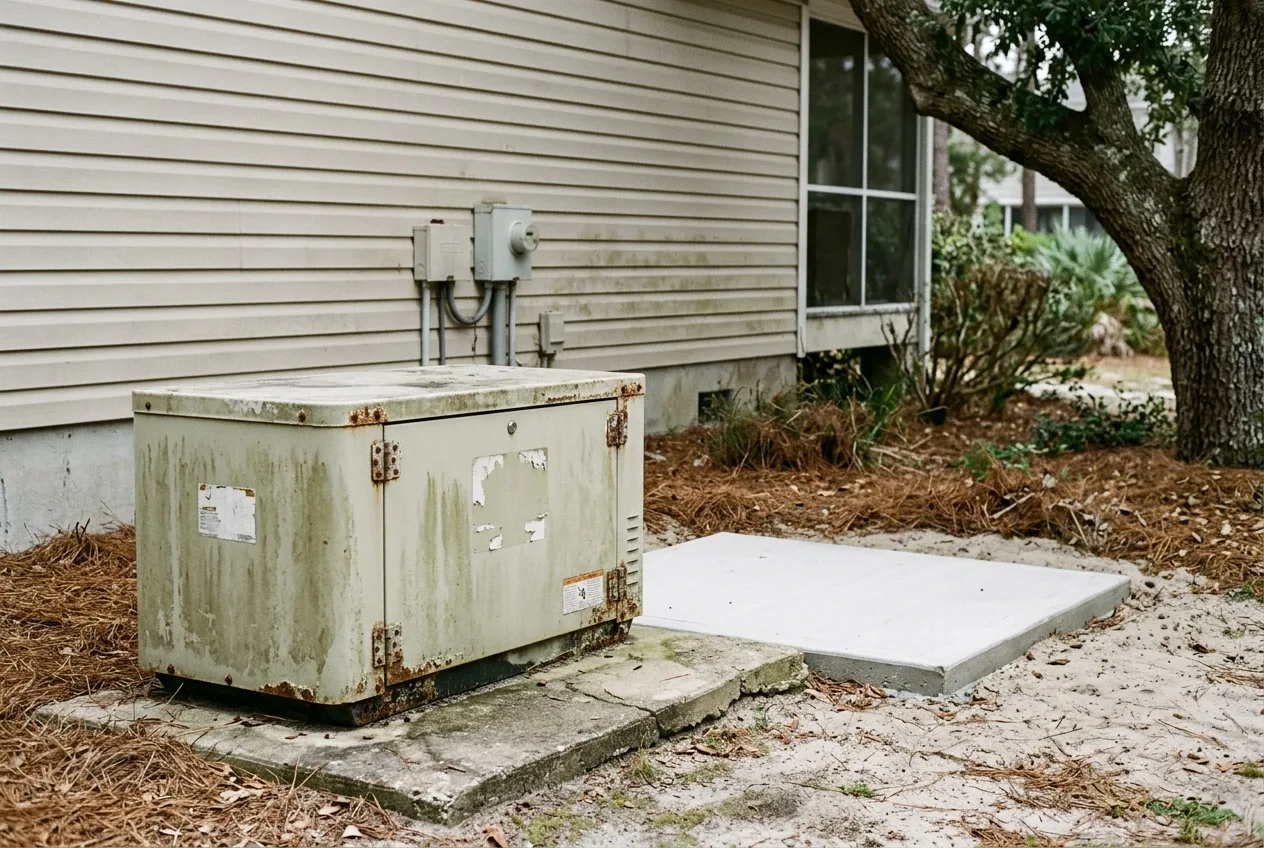
How do I know if my generator needs replacing instead of repairing?
Neither signal alone is a hard rule. A 15-year-old unit with one cheap failed part is usually still worth fixing. A 6-year-old unit with a $2,500 control-board estimate is a closer call and worth a straight conversation before you decide.
Timeline
How Long Does a Standby Generator Actually Last?
A well-maintained residential air-cooled standby generator commonly lasts 12 to 20 years, or somewhere in the range of 10,000 to 30,000 running hours, whichever comes first for a given unit.
Run hours matter more than calendar age. A generator that's run 100 hours a year, mostly for weekly self-tests and a handful of real outages, will typically outlast one that's logged 200-plus hours a year from frequent or extended outages, even if both units are the same age.
Coastal exposure is the other real variable on this stretch of coast. Salt air measurably accelerates corrosion on outdoor enclosures, connections and hardware, more so within a few miles of the ocean than in inland pockets like Carolina Forest or Conway — a unit at Cherry Grove or Garden City can show its age faster than an identical unit sitting inland.
Maintenance history is the biggest lever you actually control. A generator that's had annual service and its battery replaced on schedule routinely outlasts an identical, unmaintained unit by years.
What you get
What's Included in a Replacement?
- Old unit removal and disposalThe failed or outdated generator is disconnected, removed and disposed of properly.
- Pad, ATS and gas line assessmentChecked to see what's still code-compliant and reusable versus what needs replacing along with the generator.
- Code-current rewiring where requiredElectrical code has changed since many older units were installed; anything that no longer meets current code gets brought up to standard.
- Sizing check, not an automatic like-for-like swapA chance to correct an original unit that was undersized, or right-size if your circuit load has grown since the first install.
- Permit and commissioningNew permit filed where required, and a full startup and transfer test before the job is called done.
Step by step
How Does a Replacement Job Go?
Assessment of existing equipment
Time on site · 30-60 minutesPad, transfer switch and fuel line checked for reuse; a fresh load calculation confirms the right size for the new unit.
Permit filed
Time on site · several days to a few weeksNew electrical permit, and a gas or mechanical permit if fuel connections change.
Old unit removed
Time on site · half a dayDisconnected and hauled away.
New unit set and connected
Time on site · 1-2 daysSet on the reused or new pad, wired to the existing or upgraded transfer switch, fuel connection verified.
Startup, transfer test and inspection
Time on site · scheduled separatelyFull commissioning test, then final inspection where required.
A replacement unit sized correctly for your current circuit load, tested under a simulated outage, with anything out of code brought current.
What it runs
What Does Replacement Cost Compared to a New Install?
| Item | Typical price |
|---|---|
| Replacement reusing existing pad, ATS and gas line / installedOften less than a first-time install since site work and fuel connection are already in place. | $7,000-$16,000 |
| Replacement requiring a new pad or ATS / installedCloser to a first-time install cost if the existing infrastructure isn't reusable or code-compliant. | $9,000-$22,000 |
| Old unit removal and disposal / included in most quotesWorth confirming it's part of the price, not billed as a surprise add-on. | $200-$600 |
These are typical ranges for Grand Strand; your exact price depends on how much of the existing installation can be safely reused.
See the generator installation cost guide if you're comparing replacement cost against a completely new system.
Head to head
Repair or Replace: How Do You Decide?
Cost now vs. later · Remaining service life · Risk of repeat failure
Repair now
Best for
A unit under about 10-12 years old with a single, moderately priced failure and a decent maintenance history
Works when
- Lower upfront cost in most cases
- No disruption to the existing pad, ATS or fuel connection
Costs you
- Doesn't address other parts nearing the end of their life at the same time
- A unit with a spotty maintenance history can fail again soon after
Replace now
Best for
A unit past 15-20 years or logged run hours, or facing a repair estimate that's a large share of a new unit's cost
Works when
- A fresh warranty and a sizing check that can fix an original undersized install
- Often cheaper than a first-time install since the pad and fuel line are usually reusable
Costs you
- Higher upfront cost than a single repair
- A short disruption while the old unit is removed and the new one commissioned
Verdict
As a rough rule of thumb: if a single repair estimate is running close to half of what a comparable replacement costs, or the unit is already past 15 years with a thin maintenance history, replacement is usually the better bet. A younger, well-maintained unit with a one-off failure is almost always worth fixing instead.
Straight answers
How do I know if I should repair or replace my generator?
Compare the repair estimate against a replacement quote, and factor in the unit's age and maintenance history. As a rough guide, if repair cost is close to half of replacement cost, or the unit is past 15 years, replacement usually makes more sense.
How long do standby generators typically last?
A well-maintained residential air-cooled unit commonly lasts 12 to 20 years, or 10,000 to 30,000 running hours, with maintenance history and coastal salt-air exposure both affecting where in that range a specific unit lands.
Can you reuse my existing pad, gas line, or transfer switch?
Often yes, if they're still in good condition and code-compliant, which keeps replacement cost well below a first-time install. That gets confirmed during the site assessment before a price is quoted.
Is replacement cheaper than starting from scratch?
Usually, yes, when the existing pad, transfer switch and fuel line are reusable. Replacement typically runs $7,000 to $16,000 in that case, versus $9,000 to $25,000 for a completely new install.
What happens to my old unit?
It's disconnected, removed and disposed of properly as part of the job. That's typically included in a replacement quote, worth confirming rather than assuming.
Should I upsize when I replace an old generator?
A fresh load calculation is done as part of replacement, which sometimes shows the original unit was undersized for circuits added since it was installed. It's worth reviewing rather than assuming a like-for-like swap is automatically right.
Locked in.
Book it before the forecast turns.
An honest look at both numbers side by side, before you spend money either way.
Call it in or send the details — a real quote comes back either way.